
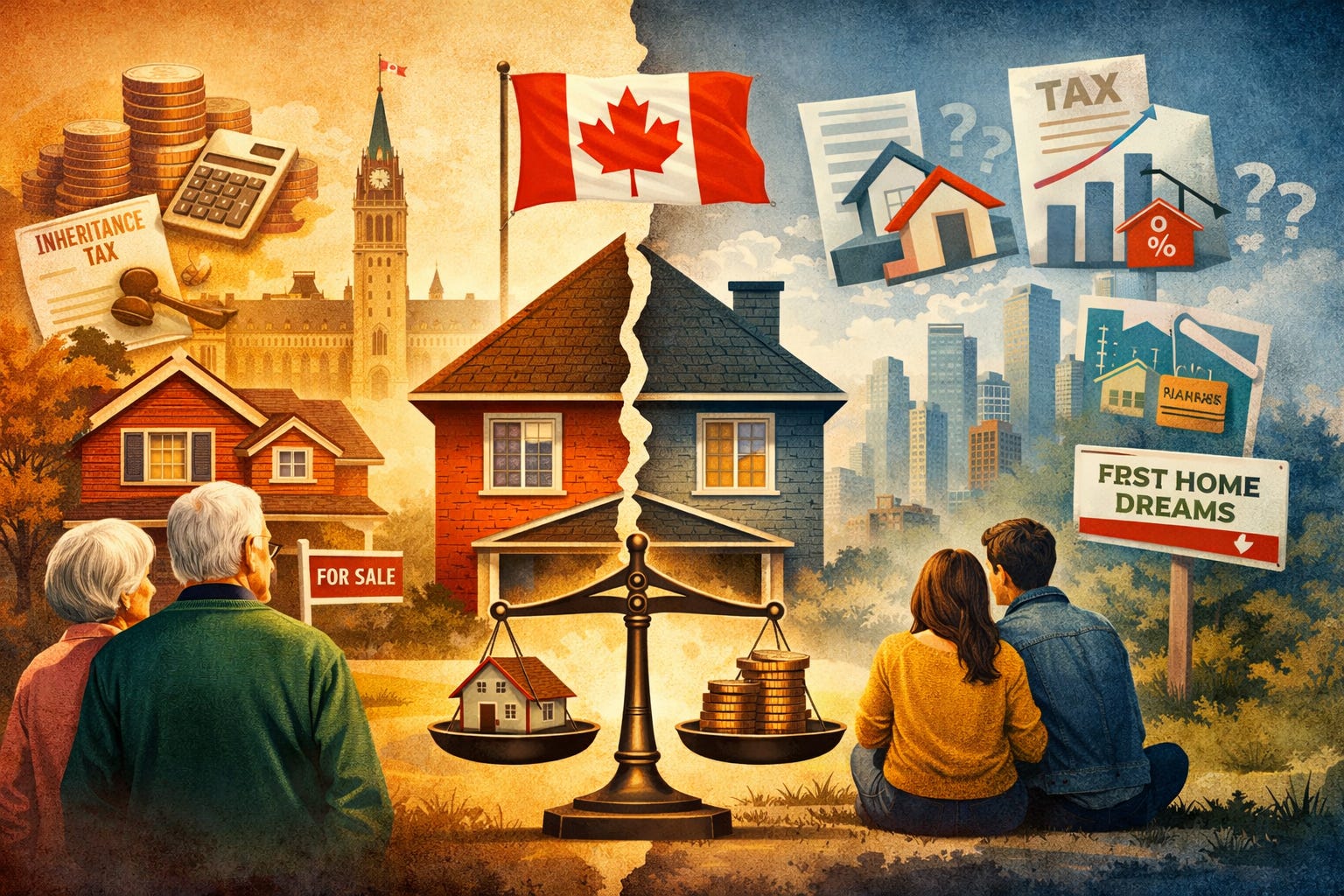
The Home Equity Tax Question: What a CMHC-Linked Housing Wealth Policy Could Mean for Canadians
A deep dive into the proposal, the politics, and the real-world consequences if Ottawa ever tried to implement it
Canada has a way of turning policy language into political folklore. A research paper becomes a rumour. A rumour becomes a talking point. A talking point becomes a kind of national anxiety. That is exactly what has happened with the idea many people now call the “CMHC-funded home equity tax.”
The phrase is emotionally effective because it contains just enough truth to travel fast. CMHC did help fund a housing-policy solutions lab connected to Generation Squeeze. Generation Squeeze did publicly advocate a surtax on home values over $1 million, starting at 0.2% and rising as high as 1%. But that proposal is not law, and Ottawa has also explicitly maintained the principal residence exemption, which continues to protect gains on the sale of a principal residence in ordinary cases.
That is where the confusion begins. The existence of a funded policy conversation is not the same thing as the existence of an implemented tax. But it would be a mistake to dismiss the issue entirely. Ideas funded, studied, and circulated in the policy ecosystem can shape future debates even when governments do not adopt them immediately. And when an idea touches the family home, retirement security, and intergenerational wealth, it deserves more than a slogan-level discussion.
This matters because housing in Canada is no longer just about shelter. It has become the central store of wealth for millions of households, the dividing line between generations, and one of the main pressure points in the country’s political economy. Any proposal aimed at housing wealth would therefore reach far beyond tax policy. It would affect retirement planning, inheritance, regional inequality, family mobility, investor confidence, municipal politics, and Canadians’ basic understanding of what homeownership is supposed to mean. That broader significance is why this policy question deserves a full, serious examination.
What the proposal actually is
The specific proposal most often attached to this debate came from Generation Squeeze’s housing work, which argued for “putting a price on housing inequity” through a modest surtax on home value above $1 million. Generation Squeeze described the surtax as starting at 0.2% and peaking at 1%, and said the goal was to reduce dependence on ever-rising home prices and improve affordability for younger Canadians.
Generation Squeeze also argued that payment could be deferred until the home is sold, specifically to address the obvious objection that some owners may be asset-rich but income-poor. That feature is politically important, because without some kind of deferral mechanism, the proposal would immediately run into the problem of imposing annual taxes on people whose wealth exists mostly on paper.
CMHC’s role was not to announce such a tax or legislate it. CMHC’s project pages describe the relevant Solutions Lab as an effort to examine “wealth and the problem of housing inequity across generations” and to identify policies that entangle Canadians in dependence on high and rising home prices. CMHC’s page describes the project as exploring policy solutions; Generation Squeeze’s own project materials say the work received funding from the National Housing Strategy’s Solutions Labs Program, while also stating that the views expressed should not be attributed to CMHC or the Government of Canada.
So the correct description is not that Canada already has a home equity tax, or even that Ottawa has adopted one in principle. The correct description is that a federally funded housing-policy ecosystem included work that generated a proposal for taxing high-value housing wealth. That distinction matters, but it does not make the proposal irrelevant. It makes it politically dormant rather than politically impossible.
Why this idea exists at all
To understand why this proposal emerged, we have to acknowledge the underlying Canadian housing reality. For decades, public policy has often rewarded rising home values while leaving affordability to deteriorate for those trying to enter the market. Generation Squeeze’s argument is that Canadians have become structurally dependent on housing appreciation as a form of wealth accumulation, and that this dependence deepens generational inequity. CMHC’s project framing similarly focused on the relationship between wealth, affordability, and intergenerational housing inequality.
The case for such a tax, from the advocates’ perspective, is not primarily punitive. It is corrective. The idea is that when public policy shelters large amounts of housing wealth from taxation, while younger workers face stagnant affordability, the tax system ends up favouring those who already own appreciating assets over those who do not. In that framework, the home is no longer merely shelter; it becomes a tax-advantaged wealth machine. A surtax on high-value homes is therefore presented as a way to reduce distortion, moderate price escalation, and rebalance the social contract between owners and non-owners.
Whether one agrees with that diagnosis or not, it is not coming out of nowhere. It is rooted in a broader anxiety about the way housing has swallowed Canadian economic life. It reflects a view that governments have spent too long treating price growth as a sign of success even when that same price growth locks out younger households and deepens inequality.
What it would mean in practical terms if implemented
If a federal government ever decided to implement a version of this policy, the first thing Canadians would need to understand is that it would not simply be “another tax.” It would amount to a redefinition of the political meaning of homeownership.
For generations, many Canadians have operated under an implicit understanding: work hard, buy a home if you can, pay off the mortgage, and whatever equity you build is yours. That understanding has been reinforced by the principal residence exemption, under which gains on the sale of a principal residence are generally not taxed when the property qualifies. Budget 2024 explicitly stated that the government would maintain that exemption so Canadians do not pay capital gains tax when selling their home.
A home-value surtax would not necessarily eliminate that exemption, but politically it would feel like a breach of the same social promise. Canadians who believed they were playing by long-established rules would suddenly be told that a portion of their housing wealth is no longer off-limits. The technical distinction between a capital gains tax, an annual surtax, and a deferred levy would matter to lawyers and policy analysts; emotionally, many households would hear one message: the government has come for the house. That perception alone would shape behaviour.
Some homeowners would feel betrayed. Others would panic. Some would rush to restructure assets, transfer ownership, or accelerate downsizing plans. Financial planners would adjust retirement advice. Adult children expecting an inheritance would reassess what their parents’ homes are actually worth after tax. Housing discourse would become even more polarized than it already is, because the issue would cut across class, age, region, and family structure in ways that do not fit neatly into left-versus-right politics.
The effect on retirees and cash-poor homeowners
This is the most politically explosive part of the entire conversation.
Canada has many households, especially seniors, whose wealth is overwhelmingly tied up in their home rather than in liquid savings. In major urban markets, an ordinary house purchased decades ago may now be worth well over $1 million, even if the owners are living on fixed retirement income. Generation Squeeze acknowledged this problem directly by suggesting that payment of the surtax could be deferred until sale.
That deferral feature would make the proposal less immediately destructive, but it would not make it painless. A deferred tax is still a tax. It would still accumulate against the property. It would still reduce the eventual net value realized by the family. It would still alter retirement calculations, estate planning, and the psychological sense of security attached to ownership. Even if the tax did not force a monthly payment, many households would still experience it as a state claim on lifetime savings.
This is why critics of the idea see it not as a narrow housing reform but as an attack on retirement security. For older Canadians who do not see their home as an “investment strategy” but as the product of sacrifice, debt, work, and time, such a policy would feel morally offensive. It would read as a punishment for having stayed put long enough for the market to revalue their neighbourhood.
And that is where the politics get dangerous. A tax can be rational in economic theory and still be politically ruinous if it violates citizens’ sense of fairness. In this case, many homeowners would not care that the measure targeted “housing inequity.” They would care that the family home had ceased to be treated as a protected sphere.
The effect on younger Canadians and first-time buyers
This is where supporters of the idea would say the pain is worth it.
The argument from the affordability side is that Canadian governments have been too reluctant to challenge the financialization of housing. If homeownership remains a lightly taxed route to wealth accumulation, then households, lenders, investors, and even politicians all become dependent on rising prices. That dependence rewards incumbents and punishes entrants. A tax on high-value housing wealth, in theory, could reduce that incentive structure and help re-anchor the system around shelter rather than speculation.
Would it actually make homes more affordable? That is less clear.
A surtax could reduce some of the social appetite for perpetual price appreciation. It could soften demand at the high end. It could create fiscal space for affordability programs. It could send a signal that government policy should no longer depend on inflating owner wealth. Those are the strongest arguments in its favour.
But it is equally possible that the direct affordability gains would be modest unless paired with major supply-side reform. If Canada continues to suffer from land constraints, zoning problems, approval bottlenecks, labour shortages, infrastructure deficits, and underbuilding, then taxing housing wealth alone will not magically restore affordability. A wealth-side intervention without a supply response risks becoming more symbolic than transformative.
In that sense, younger Canadians might welcome the symbolism while still finding that the practical path to ownership remains blocked. The policy could communicate fairness without delivering enough units, enough wage growth, or enough downward price pressure to materially change their lives. That is one reason some housing-policy debates in Canada feel so unsatisfying: they fight over distribution while the structural shortage remains unresolved.
The regional problem
One of the biggest weaknesses in any national housing-value tax is that Canada does not have one housing market. It has many.
A million-dollar home in one market may be a mansion. In another, it may be an aging detached house with no luxury character whatsoever. A national threshold therefore produces radically different social meanings depending on geography. In some cities, the tax would appear aimed at genuinely affluent households. In others, it would strike families who do not experience themselves as rich at all.
This is the kind of issue that can make a policy intellectually neat and practically combustible. A uniform national measure may satisfy simplicity, but it can violate common sense on the ground. Canadians are extremely sensitive to regional unfairness, and housing policy already amplifies that sensitivity because local prices are so visible and personal.
A government trying to solve this would need either regional indexing, complex exemptions, or a much higher threshold. But the more exceptions one builds into the system, the less clean the policy becomes and the more room there is for lobbying, avoidance, and perceived unfairness. A simple tax becomes a complicated regime. A moral argument about equity turns into an administrative battle over thresholds, appraisals, hardship provisions, appeals, and political carve-outs.
The valuation and administrative problem
This is the least exciting part of the conversation, but one of the most important.
How exactly would Ottawa determine the taxable value of millions of homes? Would it rely on municipal assessments, even though assessment cycles and methods vary? Would it require updated appraisals? Would there be federal valuation standards? Would disputes go through the CRA, a tribunal, or some hybrid system? Would jointly owned properties be treated differently? What about farms with residential components, mixed-use properties, cottages, inherited family homes, or homes held in trusts?
A housing tax does not exist in the abstract. It must be administered. And administrative design often decides whether a policy survives contact with reality.
The moment one starts asking how to value real homes in real markets, the idea becomes far more complex than its advocates often present in public messaging. That does not mean it cannot be done. It means implementation would be expensive, contentious, and highly visible. Millions of Canadians would suddenly care about bureaucratic valuation methods because those methods would determine tax exposure on their biggest asset.
This is another reason broad federal implementation is unlikely in the near term. A government does not merely have to believe in the policy. It has to survive the rollout.
The inheritance and family dimension
One of the most under-discussed implications of a home-value surtax is what it would do to intergenerational transfer inside families.
In Canada, for many households, the house is not just a residence and not just a retirement asset. It is the main inheritance. It is the thing parents hope to pass on, whether directly, through sale proceeds, or through the financial security it creates late in life. Any policy that places a growing tax claim against that asset alters the family compact around inheritance.
Supporters of the policy might respond that this is precisely the point: inherited housing wealth is one of the mechanisms through which inequality reproduces itself. Critics would respond that families should be allowed to pass on what they built without the state skimming value from the most emotionally and historically significant asset they possess.
Both arguments have force, but they lead to very different views of citizenship. One sees housing wealth as a social distortion that should be corrected for the sake of future fairness. The other sees it as a legitimate fruit of private life and family continuity. A home equity tax, if implemented, would drag that philosophical conflict into the open.
It would also deepen class division inside generations. Younger Canadians without family housing wealth might support the policy as overdue correction. Younger Canadians expecting to inherit part of a parent’s home equity might suddenly feel less enthusiastic. The proposal scrambles political alliances because housing wealth is now so embedded in family planning.
The effect on housing psychology
Markets do not move on math alone. They move on expectations.
Canadian housing has been sustained not only by demand and scarcity, but also by a deeply rooted belief that housing is the safest and most reliable path to long-term wealth. Governments have often reinforced this belief indirectly through tax treatment, public messaging, and policy design. A federal housing-value surtax would challenge that belief more directly than most recent housing measures have.
Even if the tax affected only a minority of properties, it could alter market psychology. Some buyers might become less willing to stretch into high-priced markets. Some owners might view future appreciation as less attractive if it also increases eventual tax exposure. Some investors might shift strategy. That does not guarantee a dramatic drop in prices, but it would weaken the aura of untouchability around home appreciation.
From an affordability standpoint, that may be a feature rather than a bug. From a stability standpoint, governments may fear the consequences of disrupting confidence in the housing market too suddenly. Canada is deeply exposed to housing in ways that extend into banking, household balance sheets, provincial revenues, municipal finance, and consumer spending. Policymakers know this. That is another reason they tend to talk much more boldly about housing than they act.
Why the proposal is politically weak even if the policy case exists
This is the central political truth: a proposal can make sense to some analysts and still be nearly impossible to enact.
Budget 2024 explicitly said the government would maintain the principal residence exemption. The CRA continues to state that gains on a qualifying principal residence are generally not taxed. Those are not the signals of a federal government preparing Canadians for a broad tax on primary-home wealth.
This does not mean the idea will disappear. It will continue to circulate in advocacy circles because the underlying problem has not been solved. Housing remains expensive, unequal, and politically destabilizing. But circulation is not enactment.
The reason enactment is so difficult is simple: almost any federal opposition party could frame the measure as an attack on the middle class, seniors, and family security, even if the government tried to target only high-value homes. That framing would be devastating because it speaks to something deeply embedded in Canadian identity. Homeownership is not merely an asset class in the public mind. It is bound up with responsibility, adulthood, stability, and aspiration. Any government that appears to threaten it risks being seen as hostile to ordinary life itself.
That is why the more plausible path is not a blunt home equity tax but a series of narrower, adjacent measures. Governments are more likely to pursue taxes or rules aimed at flipping, vacancy, underused housing, luxury segments, secondary properties, reporting obligations, or non-owner-occupied real estate than a direct national tax on principal residences. Those kinds of measures can be sold as targeted fairness rather than civilizational rupture. They are politically easier to survive.
What Canadians should watch for
If Canadians want to know whether this issue is becoming more than a policy ghost story, they should not focus on social media clips or partisan chain posts. They should watch for formal signals.
If Finance Canada launches consultations on housing wealth taxation, that matters. If a federal budget or fall economic statement starts distinguishing more aggressively between ordinary principal residences and “tax-advantaged housing wealth,” that matters. If a governing party starts using language that normalizes the idea that housing appreciation should bear more explicit fiscal responsibility, that matters. If the discussion shifts from advocacy groups to budget documents, then the file has entered a more serious phase.
Until then, the idea is best understood as politically real but legislatively distant.
That distinction is important because Canadians can make two mistakes here. One is complacency: assuming that because something is not law today, it is not part of the future policy environment. The other is panic: assuming that because a policy lab studied something, Ottawa is about to implement it next Tuesday. Neither is useful. Good citizenship requires watching the trajectory without surrendering to hysteria.
A moral question beneath the tax question
At the deepest level, this debate is not really about tax mechanics. It is about what Canadians believe a home is for.
Is a home primarily shelter, and should policy therefore resist treating it as a tax-sheltered engine of wealth accumulation? Or is a home legitimately both shelter and savings, such that the state should not interfere with the wealth ordinary families build through ownership over time?
That question matters because both answers contain moral truth.
The first speaks to the frustration of younger Canadians who see the ladder pulled up behind earlier generations. The second speaks to the dignity of households who sacrificed to buy a home and do not view their equity as a social problem requiring correction.
The genius and danger of housing politics is that both sides can claim fairness. That is why housing has become such a difficult file in Canada. It is not merely technical. It is civilizational. It reaches into the meaning of work, family, fairness, risk, belonging, and the future.
Conclusion
The so-called “CMHC-funded home equity tax” is best understood as a serious policy idea that emerged from a real, federally funded housing-policy context, but which has not been adopted as federal law. CMHC funded a Solutions Lab tied to housing inequity across generations. Generation Squeeze publicly advocated a surtax on home values over $1 million, with rates starting at 0.2% and rising to 1%, and suggested deferral until sale for lower-income owners. At the same time, the federal government has explicitly maintained the principal residence exemption, which remains one of the clearest signs that Ottawa is not presently implementing a broad tax on gains from selling an ordinary principal residence.
If such a policy were implemented, it would have consequences far beyond taxation. It would reshape retirement planning, inheritance, housing psychology, regional politics, and Canadians’ trust in the long-standing social bargain around homeownership. Supporters would call it overdue correction. Opponents would call it a betrayal. Both would be responding to real stakes.
That is why this issue should not be dismissed, but neither should it be sensationalized beyond the evidence. The real lesson is not that Ottawa is secretly taxing everyone’s home tomorrow. The real lesson is that Canada’s housing crisis has become severe enough that ideas once considered politically unthinkable are now being studied, funded, argued over, and kept alive in the policy bloodstream.
And once an idea enters the bloodstream, Canadians ignore it at their peril.


