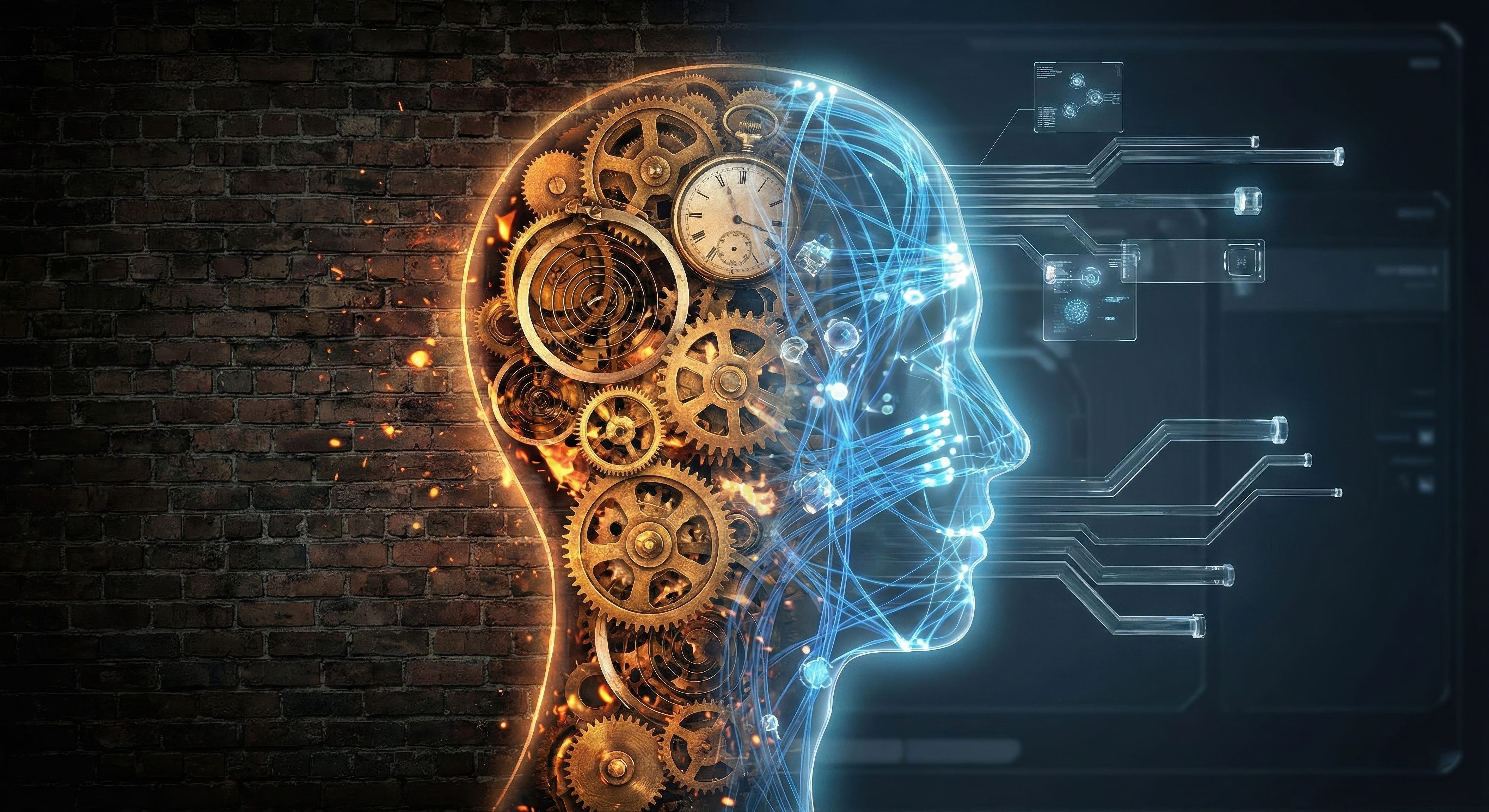
The Last Analog Humans
Why 1979–1985 isn’t “just Millennial”—it’s the bridge that built the digital world and will raise the cognitive one
There’s a particular kind of frustration that shows up whenever someone born between 1979 and 1985 hears the phrase, “You Millennials.” It’s not that the label is completely inaccurate—by many common definitions, it fits. It’s that it fails to capture something fundamental about what it felt like to grow up where we did in history. The gap between the stereotype of the Millennial experience and the lived reality of early-80s kids is wide enough that it becomes a different story.
Most Millennials did not have a fully analog childhood. Many of them have no memory of the world before the internet became a background assumption. Some grew up with computers in classrooms, with early broadband in their teens, with phones that were already smart by the time they could drive. But people born in that narrow window—late Gen X cusp through early Millennials—lived through a rarer transition. They remember the before in their bones, and they had to learn the after in real time, without a manual.
That’s why the micro-generation label “Xennial” persists: it tries to name the bridge. Not a compromise, not a blurry overlap, but a distinct lived experience. It’s the experience of being the last cohort raised in a world that operated at analog speed, while becoming adults in a world that accelerates continuously. It’s the experience of moving from paper maps and house phones to search engines and smartphones, from slow communication and local community to instant connection and algorithmic attention.
And now, as artificial intelligence ramps from novelty into infrastructure, that bridge generation is witnessing yet another threshold. This one may matter even more than the shift from analog to digital. Because the internet didn’t just change the speed of information. AI is beginning to change the location of thinking. The cognitive load we used to carry in our heads is being externalized into systems that can draft, summarize, design, propose, and predict.
If you were born between 1979 and 1985, you didn’t just watch technology evolve. You grew up while the world rewired itself twice: once when life went online, and again now as intelligence becomes embedded in tools. Your kids will live in a world where AI is normal. But you will remember what it felt like before the “always-on mind” moved into the environment.
This isn’t nostalgia. It’s context. And context is the difference between being merely shaped by history and being able to understand it.
The childhood that no longer exists
Start with the simplest truth: our childhoods were not mediated by the internet. That doesn’t mean we lived without screens—television was central, video games were rising, VHS tapes and later DVDs were common. But the structure of life wasn’t digital. The phone was a physical object attached to a wall. If you wanted to talk to a friend, you called the house and took your chances with whoever picked up. Privacy meant something different, because most communication was unrecorded and unsearchable. You could do something dumb at twelve and it would dissolve into memory instead of being archived forever.
Information also had friction. If you wanted to learn something, you couldn’t just type it into a search bar. You used encyclopedias, libraries, textbooks, and adults. It took time to find answers, and that time mattered. It trained patience. It rewarded curiosity. It forced you to decide whether a question mattered enough to go chase the answer.
Social life, too, had friction. Your friends were local. If you wanted to be with people, you physically went where they were: a friend’s house, a mall, a field, a schoolyard, a community center. Your identity was negotiated in face-to-face spaces where tone of voice and body language mattered. That didn’t make it easy—teenhood has never been easy—but it made it different. The pressure was intense in the moment, yet it didn’t follow you into your bedroom at night through a glowing rectangle.
And boredom existed. Not the performative “I’m bored” of a kid whose tablet battery just hit 1%, but actual unstructured time where nothing happened unless you made something happen. People underestimate what boredom does. It creates imagination. It produces games, stories, experiments, risk, learning. It also produces resilience, because you practice being uncomfortable without instantly escaping the feeling.
This is part of why people born in that cusp period often sound like they’re speaking a different language than younger cohorts. It’s not moral superiority. It’s that the environmental conditions that shaped our default expectations—how fast things should happen, how connected we should be, how available information should feel—were fundamentally different.
We didn’t grow up expecting the world to answer immediately. We learned to wait.
And then the world stopped waiting.
The first digital shock: when “online” became a place
If you want a moment that captures the shift, it’s the dial-up modem. That grinding, screeching handshake sound is a cultural artifact now, but it represents something historically significant: the sound of your house connecting to a network bigger than your town.
The early internet was primitive. It was slow. It was often ugly. But it carried a new kind of power: it turned communication into something that could ignore geography. It created rooms you could walk into without leaving your bedroom. It let you meet strangers who cared about the same weird niche hobby. It let you find information that would have taken days in a library. It let you publish your thoughts without getting permission from a newspaper editor.
And because it was primitive, it was also participatory. People forget this. The early internet wasn’t a set of polished platforms designed to maximize engagement. It was closer to a messy bazaar: forums, fan sites, email lists, IRC chats, GeoCities pages, weird personal blogs with neon backgrounds and animated GIFs. If you wanted a space to exist, you often had to build it or at least tinker with it.
Which means that a lot of kids born between 1979 and 1985 accidentally learned digital literacy in a way that later cohorts never had to. You didn’t just “use” the internet. You figured it out. You learned how to install drivers, how to troubleshoot, how to navigate settings, how to avoid viruses, how to compress files, how to burn CDs, how to format a hard drive when your system went sideways. These weren’t specialized skills at the time; they were survival. Technology was not seamless. It was moody. It broke. And you had to make it work.
That’s one reason this micro-generation tends to feel unusually fluent across both analog and digital worlds. You can talk to your grandparents in their language and talk to your kids in theirs. You remember a time when handwriting mattered and a time when typing speed mattered. You can navigate a physical map if you need to, but you can also navigate digital systems with the instinct of someone who grew up alongside their evolution.
It’s also why the “Millennial” stereotype often misses you. The stereotype assumes a person who grew up with the digital world already built. But the cusp cohort helped build the social layer of the digital world simply by participating early, learning the norms, and shaping what online life felt like before it became corporate infrastructure.
The second digital shock: when the internet moved into your pocket
The first internet era made “online” a place you visited. The second era made “online” a condition you lived inside.
Smartphones changed everything not because they were phones, but because they dissolved the boundary between online and offline. Before smartphones, you could leave the internet by leaving your computer. You could walk away from the screen and the internet stayed back there on the desk. Smartphones made the internet portable. They made social interaction continuous. They turned news into a constant stream. They made navigation, shopping, communication, entertainment, and identity something you carried with you everywhere.
Social media then amplified this shift. It didn’t just connect people. It connected people through algorithmic filters designed to maximize time and emotion. It restructured how we understand status, friendship, politics, and even truth. For the first time in history, a significant portion of human attention became a commodity harvested at scale.
If you were born between 1979 and 1985, you experienced this shift as an adult or near-adult, which matters. You weren’t fully formed, but you had enough sense of the “before” to feel what was changing. You could notice the psychological effects: shorter attention spans, constant comparison, perpetual outrage, the feeling of being watched, the difficulty of being fully present. You also saw the benefits: reconnecting with old friends, discovering niche communities, organizing projects, building platforms, learning faster than ever.
And importantly, you watched the internet stop being a frontier and become infrastructure. The early internet felt like a tool. The modern internet increasingly behaves like an environment. A tool you can put down. An environment reshapes you simply by existing around you.
That shift is the heart of the bridge generation story. It’s why the phrase “last analog humans” isn’t just a joke. It names a reality: you were formed in a world that did not continuously manipulate your attention from birth.
You learned how to be a person in unconnected space first.
Then you became a person inside connected space.
That is not the same as being born inside it.
Why 1979–1985 isn’t a rounding error
People sometimes dismiss micro-generations as astrology for demographics. There’s some truth to that—generational labels are always messy. But micro-generations exist because historical transitions don’t always align neatly with decade boundaries. Sometimes a technology arrives at a specific moment and affects kids of certain ages differently. The same event can shape a twelve-year-old and a twenty-two-year-old in completely different ways.
For the 1979–1985 cohort, the timing was precise. You were young enough to absorb digital skills early, but old enough to remember analog life clearly. You were early adopters when adoption was not automatic. You learned technology when it required effort. You navigated both physical and digital communities with a foot in each world.
That makes you culturally bilingual. It also makes you more likely to see the strengths and weaknesses of both eras. You can appreciate the freedom and imagination of unstructured analog childhood while appreciating the access and opportunity of digital systems. You can also see the costs: surveillance, attention capture, polarization, the erosion of privacy, the outsourcing of memory, the decline of deep focus.
This is why people in this cohort often develop a particular kind of “skeptical fluency.” They can use modern tools, but they don’t always trust them. They know how easily systems can change. They watched platforms rise and fall. They watched the utopian dream of the early internet get commercialized, politicized, and weaponized. They watched how quickly “this is just a fun app” becomes “this is how society communicates.”
That skepticism isn’t cynicism. It’s lived history.
The new threshold: from the information age to the intelligence age
Now we arrive at the present moment, and it’s bigger than most people are willing to admit.
The digital revolution was about information. It made knowledge abundant and communication instant. It connected the world. It reduced friction.
The AI revolution is about cognition. It’s about building systems that can generate language, images, designs, and decisions. It’s about outsourcing parts of thinking. It’s about intelligence becoming a service.
This is not simply “new technology.” It is a change in what tools are. For most of human history, tools extended our bodies: hammers, wheels, engines. The internet extended our reach: communication, access, distribution. AI extends—at least partially—our minds.
And when tools extend the mind, the cultural consequences go deeper. They reach into education, creativity, identity, labor, and meaning.
Children growing up now will not experience AI as a sudden disruption. They will experience it as a baseline. The same way Gen Z grew up with smartphones and social media as a baseline. Their earliest memories will include intelligent assistants, algorithmic recommendations that feel natural, and machines that can draft and create. Their schooling will adapt. Their work will adapt. Their sense of what counts as “doing it yourself” will adapt.
That doesn’t automatically mean a dystopia. But it does mean a different kind of world.
If the internet era raised the question, “How do we manage the flow of information?” the AI era raises a more personal question: “What remains uniquely human when cognition becomes assisted, augmented, and partially automated?”
That question is not philosophical fluff. It has practical consequences. It determines how people value work, how they build self-esteem, how they form identity, and how they find meaning.
When a machine can write a decent essay in seconds, the meaning of “being smart” shifts. When a machine can generate a logo instantly, the meaning of “being creative” shifts. When a machine can propose strategies and analyze outcomes, the meaning of “being competent” shifts. Humans have always adapted to technological change, but this change touches the core of how we define ourselves.
And again, the bridge generation sits in a unique place.
You remember life before search engines.
You remember life before social media.
You are now living through the early years of machine intelligence becoming normal.
You have the lived experience to recognize how large this shift is because you have already watched one world disappear and another world appear.
Parenting across revolutions
There is a special kind of psychological tension that comes from raising kids across these thresholds. Many parents feel it even if they can’t articulate it. You’re trying to teach your children values that made sense in one environment while they grow up inside another. You’re trying to instill patience in a world optimized for speed, depth in a world optimized for dopamine, and character in a world optimized for performance.
For the 1979–1985 cohort, this tension is magnified because you remember the old environment vividly. You remember what it felt like to be unreachable. You remember what it felt like to have a private childhood. You remember what it felt like to make mistakes that weren’t recorded. You remember real boredom. You remember the mental space that existed before constant input.
And now you’re raising children in a world where the default is constant input.
Your Gen Z child grew up inside social media’s rise, and probably experienced the psychological pressure of online identity: comparison, visibility, outrage cycles, group dynamics that play out publicly. Your Gen Alpha child is coming up as AI becomes woven into education and entertainment. They will likely see AI tools as normal companions the way you saw calculators as normal companions.
The parenting challenge is not simply to restrict technology or to embrace it blindly. It is to teach discernment: how to use tools without becoming shaped entirely by them.
Because the real risk of a cognitive era is not that machines become smart. The real risk is that humans become passive—outsourcing not only tasks but agency, curiosity, and responsibility. The temptation will be to let machines do the hard parts: planning, writing, thinking, remembering. The counterbalance must be taught.
And that is where the bridge generation may have a quiet superpower.
You can teach your kids what life felt like when attention was not constantly harvested. You can teach them that a mind is not a machine for output. You can teach them that solitude is not a failure state. You can teach them that creativity is not the same as production. You can teach them that being human is not merely being efficient.
Those lessons will matter.
The hidden cost of every revolution
Every technological revolution offers new powers and new costs. The costs are rarely visible at first. They arrive gradually, disguised as convenience.
The printing press democratized information but also enabled propaganda at scale. The industrial revolution expanded productivity but also created new forms of exploitation and environmental damage. The internet connected the world but also fractured attention and created new forms of surveillance and polarization.
The AI revolution will be similar. It will offer extraordinary benefits: better medical research, improved education tools, new creative possibilities, faster problem-solving, and potentially major breakthroughs in science and engineering. But it will also introduce costs: dependence, de-skilling, confusion about authenticity, and new ways for powerful entities to manipulate perception.
This is why the ability to remember a “before” matters. It gives you an anchor. It gives you something to compare against. It helps you notice what is being traded away in exchange for convenience.
People who have never lived outside the algorithmic environment can struggle to perceive it. It feels like water to fish. But those who lived before it can notice the difference in their bodies: how attention feels, how time feels, how social life feels, how quiet feels.
That perceptiveness is not nostalgia. It is a form of cultural intelligence.
The last analog humans, the first digital architects
So yes—if you were born between 1979 and 1985, you are not “just a Millennial.” You are not the same as someone born in 1995 who has no memory of a pre-internet world. You are not the same as someone born in 1970 who entered adulthood before the internet reshaped everything. You are a bridge cohort living between two worlds, and that experience shapes how you see reality.
You were among the last humans raised primarily in analog space. You learned patience and boredom and face-to-face social calibration before digital systems became dominant. You learned how to find information through effort, not instant search. You learned what privacy felt like as a default rather than a luxury.
Then you became adults as the digital world consolidated. You learned the internet when it was messy and participatory, before it became a corporate environment. You watched social media restructure culture. You watched smartphones merge online life with everyday life. You watched the world change faster than our institutions could adapt.
In that sense, you are the first digital architects not because you personally coded the internet, but because your cohort helped normalize it, shape its culture, build its communities, and establish the behavioral patterns that the modern digital world inherited. You were early enough to participate in the shaping, not merely inherit the finished product.
And now you are raising children who will be the first cognitive era adults.
That is the story.
Not a demographic trivia fact.
A civilizational transition.
What this means going forward
The most important work of the coming decades will not be technical. It will be cultural and moral.
Technology will continue to advance. That is the easiest prediction in the world. The hard question is whether human beings will develop the wisdom to live well inside the environments we create. The tools are becoming increasingly powerful. The question is whether our values and institutions can keep up.
This is where the bridge generation may matter more than it realizes. You have the perspective to see what was gained and what was lost. You understand both analog and digital worlds. You can translate between generations. You can help your children interpret a future that will feel normal to them but is historically unprecedented.
If there is a role to play, it is this: be the generation that insists on humanity.
Not in the sense of rejecting technology, but in the sense of refusing to let convenience erase the deeper skills of being alive: attention, discipline, patience, empathy, responsibility, courage, discernment, and meaning.
Because in a world where machines can generate words, images, and strategies at the press of a button, the value of a human life will not be measured by output. It will be measured by judgment. By character. By the ability to choose wisely what to do with power.
That’s what parents will teach. That’s what communities must rebuild. That’s what education must prioritize. And that’s what leadership must understand if we want the next revolution to elevate human dignity rather than hollow it out.
If you were born between 1979 and 1985, you stand in a rare place in history. You remember the world before it went online. You helped build the world that did. And now you are watching intelligence itself become part of the environment.
That doesn’t make you better.
But it does make you uniquely positioned.
You are the last analog humans.
And the first digital architects.
And whether you realize it or not, you may also be the first generation tasked with raising human beings who will have to define what humanity means in the age of artificial minds.