
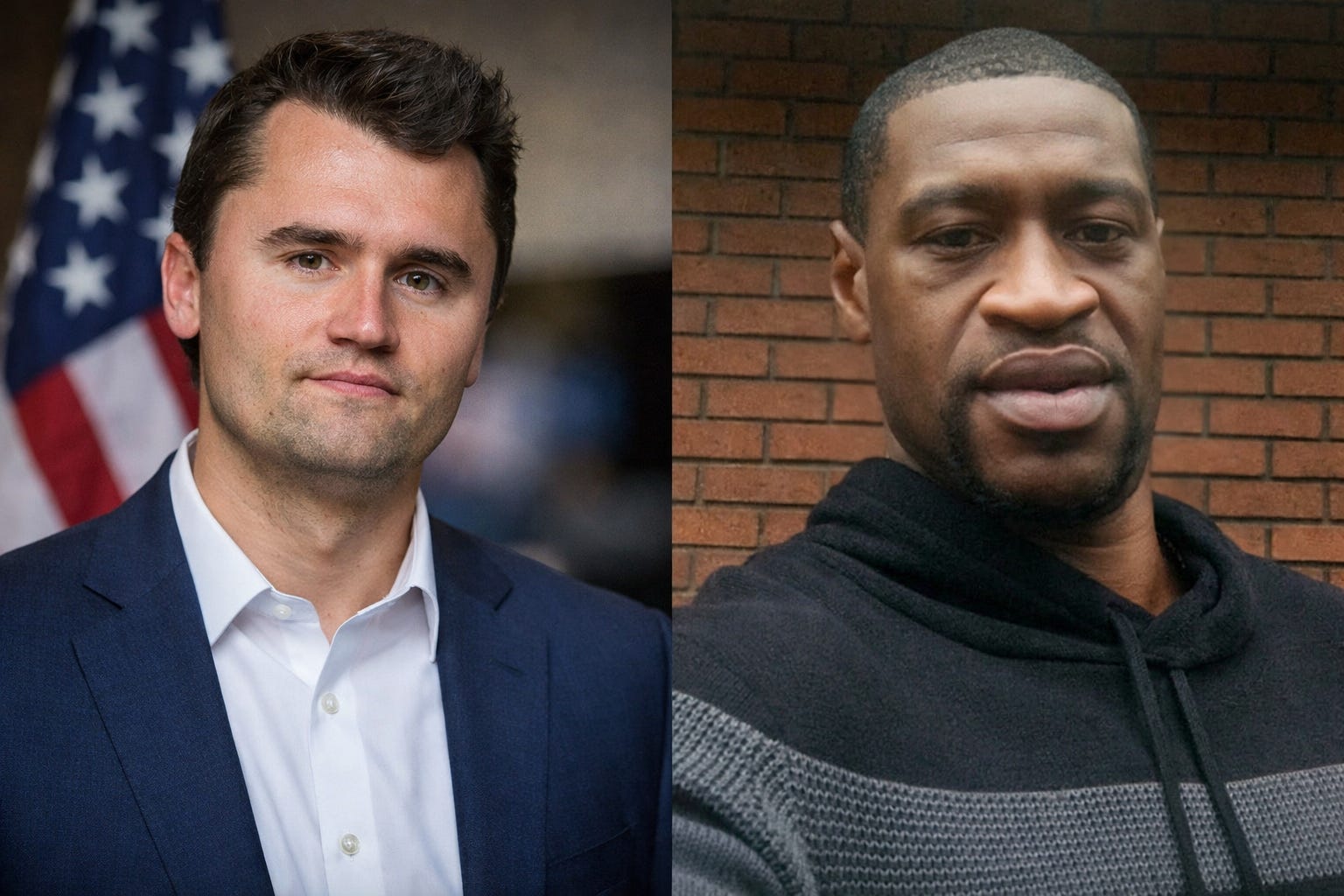
Two Deaths, Two Americas
George Floyd, Charlie Kirk, and the Moral Asymmetry We Refuse to Confront
Part I of a Two-Part Series
America does not merely disagree anymore.
It mourns differently.
It excuses differently.
And most disturbingly, it decides whose death is sacred and whose death is acceptable.
To understand how deep the fracture runs, we must confront two names that now occupy radically different places in the American conscience: George Floyd and Charlie Kirk.
Both men are dead.
Both deaths were violent.
And the way the nation responded to each exposes a moral asymmetry so severe it is impossible to ignore.
George Floyd: A Death That Became Untouchable
George Floyd died in Minneapolis in May 2020 during an encounter with police. The video was horrifying. It spread instantly, igniting grief, rage, and a national reckoning.
Certain facts are uncontested:
Floyd had fentanyl and methamphetamine in his system
He had a criminal history, including drug offences
He was already in medical distress when the police arrived
None of these facts justify his death. No one strips him of humanity.
But something unusual happened almost immediately after.
Public mourning hardened into moral absolutism. Floyd was elevated beyond criticism, beyond context, beyond complexity. Any attempt to discuss toxicology reports, prior criminal behavior, or conflicting medical testimony was treated not as analysis—but as moral failure.
The unrest that followed lasted months. Entire neighbourhoods burned. Businesses were looted. People were assaulted and killed. And yet, again and again, the public was told these were “mostly peaceful protests,” even as live broadcasts showed buildings in flames.
The message was unmistakable:
This violence was tragic—but understandable.
This destruction was regrettable—but justified.
The cause, many insisted, outweighed the cost.
Charlie Kirk: A Man Killed for Speaking
Charlie Kirk was not under arrest.
He was not resisting law enforcement.
He was not fleeing authorities.
He was not committing a violent crime.
He was sitting in a chair, speaking.
In September 2025, Charlie Kirk was shot and killed at a public event. An assassination. A political killing. A man murdered not for what he did, but for what he believed and said out loud.
And what followed was not national mourning.
What followed was mockery.
Minimization.
Justification.
In some ideological spaces, his death was framed as a “consequence.” In others, it was met with silence so loud it bordered on approval. Jokes circulated. Dehumanization continued uninterrupted. There were no months-long riots demanding justice for him. No insistence that his life be treated as sacred beyond question.
Instead, the response revealed something far darker.
The Moral Double Standard
Here is the asymmetry that defines modern America.
After George Floyd’s death:
Violence was excused as righteous anger
Questioning the narrative was treated as hatred
Floyd was elevated into an untouchable symbol
After Charlie Kirk’s assassination:
His death was minimized or mocked
Some openly celebrated it
Others treated it as morally unremarkable
If an effigy of George Floyd is defaced, it is labelled a hate crime.
If memorials for conservative figures are destroyed, it is dismissed as activism.
If violence erupts after Floyd’s death, it is framed as understandable pain.
If a man is assassinated for speaking, it is framed as “what happens when you provoke people.”
This is not justice.
This is selective morality.
What This Says About Us
This article is not about defending Charlie Kirk’s politics.
It is not about condemning George Floyd’s character.
It is about asking a question that too many people are afraid to answer:
Why does one side insist that criminal history is irrelevant to moral worth—
while insisting that ideological disagreement justifies hatred, dehumanization, and even death?
A society that cannot apply the same moral standards to people it disagrees with is not divided.
It is broken.
If violence is wrong, it must be wrong even when we sympathize with the cause.
If human dignity is inherent, it must apply even to people whose ideas offend us.
When morality becomes tribal, truth becomes optional.
And when truth becomes optional, violence is never far behind.
Coming in Part II
In the next article, we will examine another death—already being framed as the next national symbol—and ask the hardest question of all:
Who decides which lives are worth riots, and which are worth silence?


