
When Evidence Stops Mattering
The DoorDashGirl Case and the Breakdown of Public Reason
There are moments when a viral controversy does more than dominate a news cycle. It exposes something deeply unsettling about how we, as a society, now think — or fail to think — about truth, evidence, and responsibility. The so-called “DoorDashGirl” case is one of those moments.
From the very first video, something about this story didn’t sit right with me.
I remember watching it and feeling confused in a very specific way — not emotionally conflicted, but intellectually puzzled. What I saw was a woman filming a man who appeared to be asleep on his couch. He wasn’t moving. He wasn’t speaking. He wasn’t interacting with her in any visible way. And yet the framing of the video suggested something sinister had occurred.
When she later claimed she had been sexually assaulted, my reaction wasn’t disbelief so much as disbelief mixed with genuine confusion. I wasn’t thinking, That can’t be true. I was thinking, How?
What, precisely, is being alleged here? What action took place? What mechanism of assault is even being claimed?
Those questions never received coherent answers — and as more details emerged, the entire narrative began to unravel.
Feelings Are Not Crimes, and Discomfort Is Not Assault
One of the most dangerous shifts in modern discourse is the erosion of the distinction between feeling unsafe and being criminally harmed. These are not the same thing, and treating them as interchangeable does immense damage — particularly to real victims of real crimes.
Criminal law does not operate on vibes, impressions, or retrospective interpretations of fear. It operates on actions and intent. There must be an act, and there must be intent. Without both, there is no crime.
In this case, the man at the center of the controversy was reportedly intoxicated and unconscious in his own home. An unconscious person cannot form criminal intent. An unconscious person cannot commit a crime. That is not a controversial legal position — it is foundational.
Being partially or fully unclothed in one’s own home is not a crime. It is not harassment. It is not assault. It is not even unusual. Private spaces are not governed by the exact expectations as public ones, and the law is very clear about that distinction.
Once you accept those basic facts, the original accusation collapses under its own weight.
When the Facts Flip the Script
As police reports and additional evidence came to light, the story didn’t merely weaken — it inverted.
According to what has been publicly reported, the delivery instructions were to leave the food at the door. Instead, she opened the door herself and entered the home. Ring camera footage reportedly shows her initiating entry, not being invited in, not being coerced, and not being interacted with. The man remained unconscious throughout.
At that point, the question is no longer “Was she endangered?” but “Why was she filming a private individual inside his own home?”
Recording someone without consent in a private residence is not protected behaviour. Posting that footage publicly is even more serious. When those actions are paired with a public accusation of sexual assault — an accusation unsupported by evidence — the harm becomes profound.
Reputations are not abstractions. Once an accusation like that is released into the wild, it cannot be fully retracted. Even if the legal system clears someone, the stain remains.
This is where the uncomfortable reality sets in: the person initially framed as the victim begins to look very much like the perpetrator.
Why So Many People Refused to Accept the Evidence
What troubled me most was not that someone made a false claim — that happens. What worried me was how aggressively large numbers of people clung to that claim even as it became increasingly indefensible.
We are living through a collapse of public reasoning, where narratives are chosen first, and facts are selected later — if they are considered at all. Once someone is emotionally categorized as a “victim,” evidence to the contrary is treated as cruelty rather than correction.
Social media accelerates this process. The first version of a story spreads the furthest. Corrections never catch up. And platforms reward emotional intensity far more than accuracy. A tearful video will consistently outperform a police report.
There is also a cultural pressure at play: questioning a claim is framed as a moral failure. Skepticism is labelled “victim-blaming,” even when that skepticism is grounded in video evidence, sworn statements, and basic logic.
This dynamic does not protect victims. It undermines them — because when false claims are defended at all costs, real claims become harder to believe.
The Breakdown When the Story Stops Paying
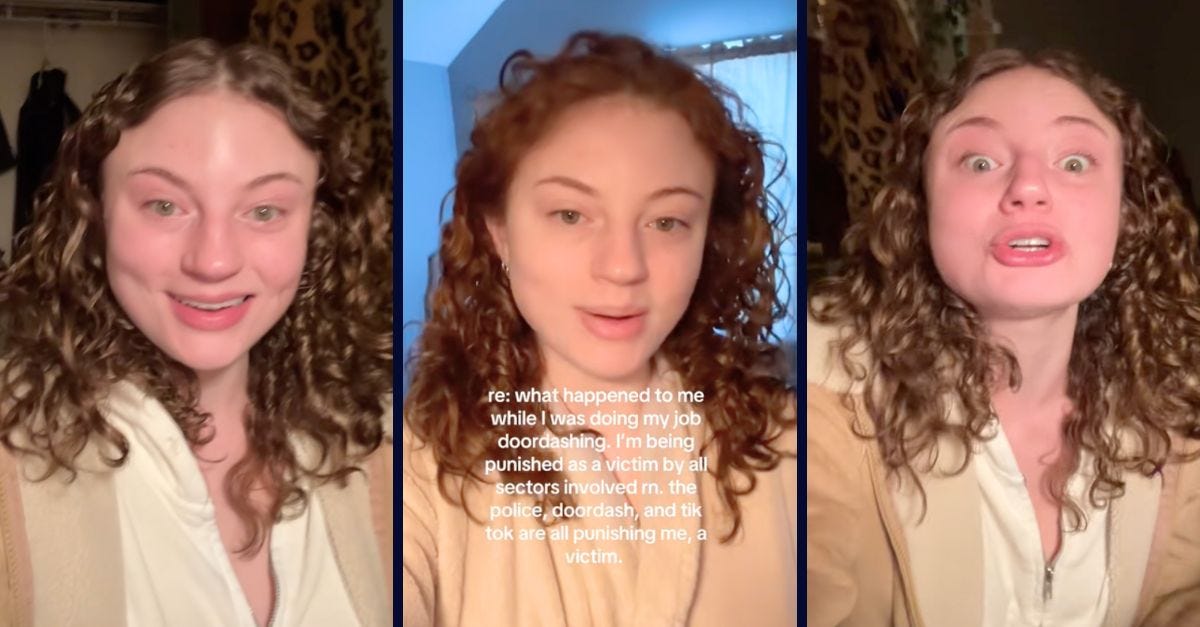
One of the most revealing aspects of this case came later, when platforms began to pull back. Accounts were suspended. Monetization was removed. Videos stopped generating revenue. And the response was not reflection or accountability — it was fury.
What followed were emotional outbursts, repeated insistence on victimhood, and public complaints about being unable to profit from the situation anymore. The focus shifted noticeably from justice or safety to lost income and silenced reach.
That shift matters.
When someone has been genuinely harmed, their concern is typically protection, healing, or accountability. When someone is exposed, their concern is losing control of the narrative. The intensity of the reaction to disbelief suggested not a wounded victim but a person unable to tolerate a reality in which their story was no longer being affirmed.
The Legal Gamble of Denial
There is another layer to this that deserves serious attention. Continuing to plead complete innocence in the face of strong evidence is not just defiant — it is dangerous.
Courts take into account not only what a defendant did, but how they conduct themselves afterward. Denial in the face of clear evidence, lack of remorse, and the infliction of reputational harm all weigh heavily at sentencing. A guilty plea combined with accountability often leads to reduced penalties. A conviction after trial frequently does the opposite.
If this case ends with severe consequences, it will not be because society hates victims. It will be because the legal system still operates on evidence, even when the public discourse does not.
What This Case Really Reveals
At its core, this controversy is not about one woman or one man. It is about a culture that increasingly treats subjective experience as objective truth and emotional narratives as moral trump cards.
We are drifting toward a world where evidence is optional, accountability is oppression, and reality itself is negotiable. That is not compassion. It is decay.
If a man cannot be unconscious in his own home without being accused of a crime, and if the person who violated his privacy is still celebrated as a victim despite overwhelming contrary evidence, then something has gone deeply wrong.
Truth matters. Evidence matters. And insisting on those things is not cruelty — it is the minimum requirement for a functioning society.
If that makes people uncomfortable, then perhaps discomfort is the beginning of thinking again.


