
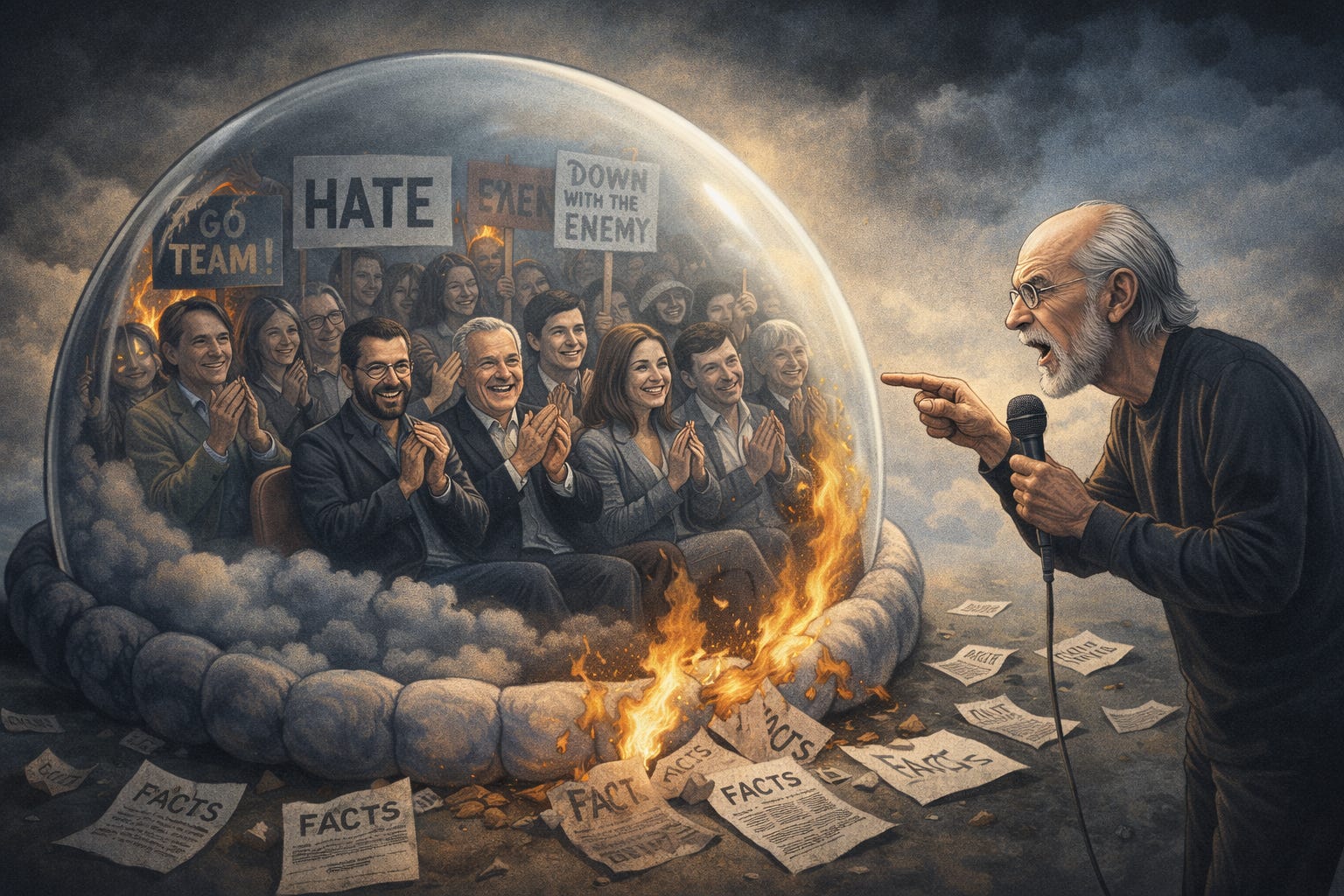
When Identity Replaces Thought
George Carlin and the Death of Disagreement
There was a time when ideas were things you had.
You could hold them, test them, discard them, or replace them.
Then something changed.
As George Carlin observed with ruthless clarity, modern people no longer hold ideas — they become them. Identity fuses with ideology, and the moment that happens, thinking stops being a process and turns into a threat.
Carlin didn’t just mock this shift. He diagnosed it.
“People don’t want to hear the truth. They want reassurance. They want to be comforted. They want to be told they’re right.”
Once belief becomes identity, disagreement stops sounding like disagreement.
It sounds like an attack.
And when people feel attacked, they don’t reason — they retreat.
The Bubble
Carlin understood something that social media would later industrialize:
People build bubbles not to learn, but to feel safe.
Inside the bubble:
everyone agrees
everyone speaks the same language
everyone hates the same enemies
everyone applauds on cue
The bubble isn’t about truth.
It’s about belonging without effort.
“Think of how stupid the average person is, and realize half of them are stupider than that.”
Carlin wasn’t calling people stupid for lacking intelligence.
He was calling them intellectually lazy — outsourcing thinking to the group so they wouldn’t have to risk standing alone.
Why Facts Stop Working
One of Carlin’s most uncomfortable insights is that facts are useless once identity is on the line.
If you challenge an idea someone merely holds, they may reconsider.
If you challenge an idea someone is, you’ve threatened their existence.
So facts bounce off.
Logic is ignored.
Humour — once a bridge — becomes offensive.
“Scratch any cynic and you will find a disappointed idealist.”
People double down not because they’re convinced — but because retreat feels like annihilation.
Admitting error would mean admitting they are wrong.
And that is intolerable in a culture that confuses self-worth with certainty.
Sacred Nonsense
Carlin watched as nonsense became untouchable — not because it was true, but because it was symbolic.
Beliefs hardened into doctrine.
Language became ritual.
Questioning turned into heresy.
“I don’t believe anything the government tells me. Ever.”
This wasn’t paranoia. It was epistemic humility — an insistence that authority, popularity, or moral confidence do not equal truth.
Carlin didn’t demand that people adopt his conclusions.
He demanded they earn them.
The Real Cost
Here’s the part Carlin rarely softened:
When ideology replaces personality, people stop growing.
Without the script, there’s nothing underneath.
No curiosity.
No humor.
No resilience.
Just repetition — louder, angrier, and more certain each time.
And certainly, Carlin warned, is the enemy of wisdom.
“The main reason Santa is so jolly is because he knows where all the bad girls live.”
Even in jokes, he reminded us:
Humour dies the moment people take themselves too seriously.
My Reflection
George Carlin wasn’t offering solutions.
He was holding up a mirror — and daring people not to look away.
In an era obsessed with identity, his work remains a warning:
Ideas are tools, not temples.
The moment you can’t question what you believe is the moment you stop thinking — and start defending emptiness like scripture.
And if that happens, the problem isn’t disagreement.
The problem is that without the belief, you’d have to discover who you are.
Editor’s Note
This piece draws from the themes, language, and worldview of George Carlin’s late-career work. Quotations are used for commentary and analysis under fair use.


