
When Mercy Becomes Policy
MAiD, Mass Violence, and the Quiet Crisis Beneath the Numbers
There are statistics that inflame.
And then there are statistics that unsettle.
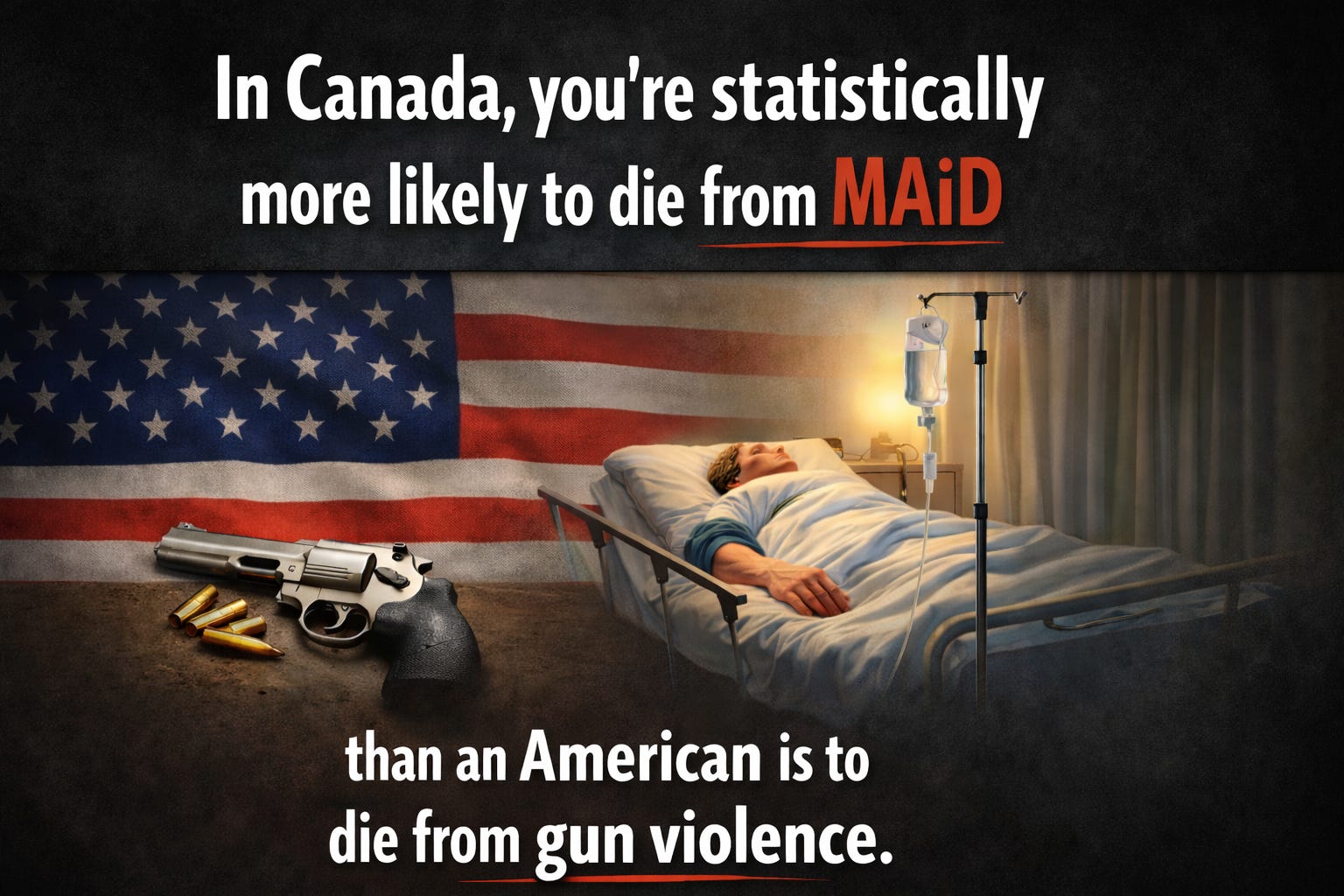
Recently, comparisons have circulated showing that Canada’s Medical Assistance in Dying (MAiD) rate per capita now exceeds the United States’ firearm homicide rate — and even approaches or surpasses total U.S. gun deaths depending on how the numbers are framed.
The reaction to this comparison is predictable. Some use it to condemn Canada. Others dismiss it as misleading. Many refuse to engage with it at all.
But perhaps the wrong question is being asked.
The issue is not whether one country is “worse” than the other.
The issue is why both countries are producing so many people who no longer wish to continue living.
That is not a partisan question.
That is a civilizational one.
Two Nations, Two Manifestations of Distress
In the United States, despair often surfaces in violence — outward, chaotic, explosive.
In Canada, despair increasingly surfaces through a clinical, procedural mechanism — quiet, regulated, sanctioned.
One ends in headlines.
The other ends in paperwork.
Both end in death.
When Canada expanded MAiD eligibility, it did so under the language of compassion and autonomy. The initial framework was tied tightly to terminal illness and unbearable physical suffering. For many Canadians, that seemed understandable — tragic, but understandable.
But eligibility discussions have widened. Mental illness has been debated. Chronic conditions have raised difficult questions. And stories have emerged that leave people uneasy — including reports of individuals with treatable or manageable conditions being deemed eligible.
As someone living with diabetes, I cannot ignore that discomfort. Diabetes is serious. It can be exhausting. It can shorten life. But it is also treatable. It is manageable. It is not, in itself, a death sentence.
So when a person with such a condition reportedly qualifies for assisted death, the question becomes unavoidable:
Are we responding to suffering — or to hopelessness?
And if it is hopelessness, have we done everything possible to treat that first?
The Religious Tension and the Secular Reality
My own position contains tension.
Religiously, I do not believe in self-termination. I believe life carries intrinsic dignity, even in pain. Suffering is not meaningless, even when it feels unbearable.
But public policy cannot be built solely on personal theology.
In a pluralistic society, law must account for people who do not share my religious convictions. And so I find myself acknowledging something difficult: if every medical avenue has truly been exhausted, if suffering is irreversible and profound, if autonomy is clear and coercion absent, then a structured, regulated end-of-life option may be preferable to violent alternatives.
That is not an endorsement.
It is an admission of moral complexity.
Yet the phrase “last resort” must mean something real.
If assisted death becomes easier to access than mental health care…
If poverty, isolation, or untreated depression quietly shape eligibility…
If exhaustion from navigating a broken system becomes the tipping point…
Then we are no longer talking about mercy.
We are talking about failure.
What Are We Avoiding?
When Americans debate gun violence, they often circle around the mental health question but rarely invest in solving it at scale.
When Canadians debate MAiD expansion, they often speak of autonomy but less frequently confront whether social supports are sufficient for the vulnerable.
In both countries, the through-line is mental distress.
Gun suicides account for a large portion of U.S. firearm deaths. That fact alone complicates simplistic narratives about violence. It also forces us to confront something uncomfortable: many of these deaths are not acts of aggression. They are acts of despair.
Similarly, if MAiD increasingly includes cases rooted in psychological suffering, then we are facing despair in a different form — but despair nonetheless.
The question then becomes:
Is society investing more in ending suffering — or ending sufferers?
That may sound harsh. It is meant to.
Because if the answer is the latter, even partially, we must slow down.
The Meaning of Dignity
Supporters of MAiD often speak of dignity.
Critics often speak of sanctity.
Perhaps the real tension lies in how we define dignity.
Is dignity the ability to choose one’s death?
Or is dignity the assurance that one’s life is worth sustaining, even when difficult?
In a healthy society, those questions would not collide. Dignity would be protected both in life and in death.
But in a strained society — one marked by loneliness, economic pressure, underfunded mental health systems, and fraying communities — autonomy can blur with abandonment.
And that is where caution must live.
A Necessary Evil, or an Expanding Convenience?
If assisted death exists, it must remain rare. It must remain solemn. It must remain burdensome in process — not to punish, but to protect.
Not because autonomy is unimportant.
But because vulnerability is real.
There is a moral difference between:
“I have exhausted every path, and suffering is irreversible.”
And:
“I am tired, isolated, unsupported, and see no way forward.”
One describes terminal reality.
The other describes societal neglect.
If we cannot distinguish clearly between the two, then expansion becomes ethically dangerous.
What Kind of Country Do We Want to Be?
The United States struggles with violence that is loud and public.
Canada wrestles with a form of death that is quiet and procedural.
Neither country can afford moral complacency.
The deeper question is not whether MAiD numbers exceed gun death numbers.
The deeper question is why modern societies — wealthy, medically advanced, technologically connected — are producing so many citizens who no longer see life as bearable.
Until we answer that, statistics will remain ammunition for debate rather than catalysts for reform.
And reform is what is actually needed.


